
LEED Liability: Owner Sues Material Supplier for Defective “Green” Material |[MD DIST CT]|
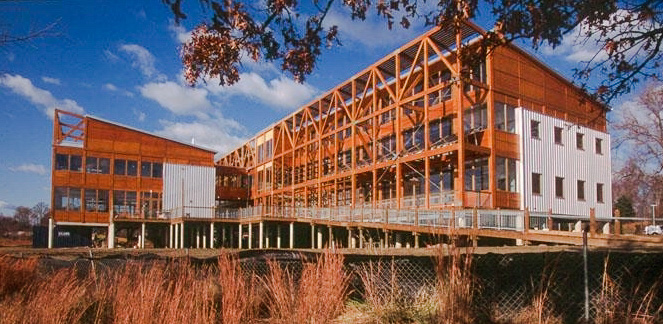 Chesapeake Bay Foundation’s Philip Merrill Environmental Center – Annapolis, Maryland
The Chesapeake Bay Foundation saga was a six-year litigation process after nearly ten years had passed since the project completion. Central to the case, the owner and architect risked design reliability to achieve green building objectives and lost. This is a story about the first LEED Platinum-certified building and its subsequent design defect litigation.
In 1999, the Chesapeake Bay Foundation contracted with SmithGroup architects to design and build the Philip Merrill Environmental Center near Annapolis, Maryland. Focused on promoting sustainable development on the Chesapeake Bay, the Foundation instructed SmithGroup to incorporate “green” building techniques in order to obtain a platinum certification (the highest LEED certification standard) under the Leadership in Energy and Environmental Design (LEED) program. Accordingly, SmithGroup incorporated sustainable materials in the building design, including the use of parallel strands of lumber (PSL) glued together, called Parallams, on the building’s exterior façade. Manufactured from rapidly renewable second-growth trees, LEED awards users more points during the green certification process. However, Parallam benefits do not come without costs. Because Parallam pieces require bonding smaller strips of wood together, it creates channels that longitudinally run through it in which water can infiltrate and rot over time. SmithGroup recognized this problem and sought to resolve it by requiring contractors to treat the Parallams with a preservative called PolyClear 2000. To that end, SmithGroup specified the use of PolyClear 2000 in the designs it provided for the project general contractor, Clark Construction. Then, in a purchase order agreement, Clark instructed a Parallam supplier, Weyerhaeuser Company, to treat all ordered Parallams with PolyClear 2000. Weyerhaeuser contracted the treatment out to Permapost Products Company. In Permapost’s Acknowledgement of Order, it specified that it had never treated exterior-used Parallams with PolyClear 2000 and stipulated that any potential damages should be limited accordingly:
“No claim of any kind shall be made in excess of the purchase price of the product sold hereunder with respect to which damages arise.” – Permapost Acknowledgement of Order provision
In December 2000, Clark Construction completed the project and the Foundation moved in.
A few months later, the occupants noticed leaks inside along the exterior walls and hired an engineer to conduct a survey. In his report, the engineer noted the potential (emphasis added) deterioration of the Parallams and the “cause for concern” due to their outside exposure. In 2002, the leak investigation continued and concluded that there was existing (emphasis included) damage to the Parallams:
“The pressure-treatment along with the 3–coat finish system has failed to keep the wood protected. The voids and splits in the Parallam have allowed the water to enter the wood causing the wood to swell and the repeated reduction of that humidity causing the wood to shrink. That shrinking and swelling movement has caused cracking at the joints, the wood to warp and become out of plane at the interior column joints.” – 2002 Leak Investigation Report
During the investigation, Weyerhaeuser allegedly assured the Chesapeake Bay Foundation, SmithGroup, and Clark that the Parallams were properly treated and appropriate for the project. Investigations continued on and off until 2005, at which point the leak appeared to be resolved and remediation efforts ceased. In September, 2009, during an annual inspection, the Foundation allegedly discovered the deterioration of the Parallams for the first time. A third-party inspector recommended the removal and replacement of certain Parallams on account of deterioration. The Foundation notified SmithGroup and Clark of the need for remediation. Clark then notified Weyerhaeuser and requested their cooperation in remediation. Weyerhaeuser declined to participate. Consequently, the Foundation, SmithGroup, and Clark executed a remediation agreement under which the latter two agreed to remediate the damage and pursue litigation against Weyerhaeuser for costs.
On December 3, 2010 (nearly 10 years after project completion), the Chesapeake Bay Foundation, joined by SmithGroup and Clark, sued Weyerhaeuser for, among other things, negligent treatment of the Parallams and breach of contract for failure to indemnify Clark and SmithGroup for remedial measures taken. After removing the case to federal court, Weyerhaeuser filed counterclaims against the plaintiffs and filed a third-party complaint against Permapost asserting claims for breach of contract, negligence, common law indemnification, and contribution. The third-party claims were conditioned, however, against Weyerhaeuser’s primary defense that the plaintiffs were time-barred from the complaint under Maryland’s three-year statute of limitations.
In response to Weyerhaeuser’s motion for summary judgment, the federal district court judge granted the motion finding that the statute of limitations had run. Pursuant to Maryland’s discovery rule that bars the statute of limitation time from accruing until after the claimant knows or reasonably should have known of the damage, the district court judge determined that the Foundation should have known of the Parallams’ deterioration from the 2002 report. The Foundation appealed the decision.
In CHESAPEAKE BAY FOUNDATION, INC., ET AL. v. WEYERHAEUSER CO., 580 Fed.Appx. 203 (4th Cir. July 31, 2014), the Fourth Circuit Court of Appeals determined that the lower court was wrong to infer that the Foundation had discovered the deterioration before 2009 and, therefore, vacated the summary judgment. It found that a genuine dispute existed as to whether “the water infiltration problem would have put a reasonable person on notice that the Parallams were susceptible to premature deterioration and that their PolyClear 2000 treatment would not preserve them.” In other words, the court found that the lower court improperly relied on the assumption that any ordinary person would know that wet wood rots. The court remanded the case back down to the district court for reexamination of the claims.
In CHESAPEAKE BAY FOUNDATION, INC., ET AL. v. WEYERHAEUSER CO., 2015 WL 2085477 (S.D. Md. May 4, 2015), the district court denied Weyerhaeuser and Permaposts’ motions for summary judgment for negligence in addition to Weyerhaeuser, Clark, and SmithGroup’s motions for summary judgment for indemnification. First, the court evaluated Permapost’s motion based on expert opinion testifying that the Parallams would have rotted regardless of using the PolyClear preservative and, thus, Permapost’s treatment was not the cause-in-fact. Although both sides’ wood experts testified that the Parallams would have rotted regardless, neither addressed the sufficiency of Permepost’s application of PolyClear. The court determined that a genuine issue of dispute still existed and denied the motion.
In response to the indemnification motions, the court found that SmithGroup and Clark failed to show any payments made under the remediation agreement for Weyerhaeuser to indemnify. Because indemnification claims were filed prior to payments made, the court dismissed the motion. However, noting that three years had passed since the plaintiffs’ initial indemnification claims (March 2012), the court permitted SmithGroup and Clark to produce evidence of payments made in the interim.
On July 23, 2015, the Chesapeake Bay Foundation, SmithGroup, Clark, and Weyerhaeuser settled outside of court. The third-party complaint against Permapost, however, remained unaffected.
In WEYERHAEUSER CO., ET AL. v. PERMAPOST PRODUCTS CO., No. PWG-11-47, 2015 WL 11121042 (S.D. Md. Nov. 17, 2015), the district court rendered judgment in favor of Permapost. The court found that Weyerhaeuser was unable to establish that Permapost’s application of the PolyClear 2000 was the cause. Instead, the court found that the defect was in the design rather than manufacturing. “I find, given, one, the inappropriate use of Parallams as structural support without proper weather protection, plus I find that the specification by the architect based upon the recommendation of Weyerhaeuser…but not Permapost,…PolyClear 2000 was an inappropriate preservative for the conditions of the Chesapeake Bay Foundation.”
Best Practices:
- Balance LEED Innovation Credit against risks of untested materials and designs – Enticed by LEED credits, the various parties took a risk in using Parallams on the exterior which resulted in water damage.
- Ten-Year Statute of Repose – Similar to Maryland law, Ohio law bars all claims against construction defects brought after 10 years of substantial project completion. In Ohio, however, the statute of repose has one exception. That is, if the defect is discovered between eight to ten years after project completion, the claimant receives an additional two years to sue after such discovery. Accordingly, a claimant could discover the defect nine years and eleven months after completion and then receive a two-year extension before the statute bars their claim.
- Limit duty to indemnify within the scope of the contract – Parties to a contract can have duties to indemnify by contract and/or common law. In Weyerhaeuser, the court extinguished Clark’s common law indemnification claim after reading a provision in the Clark-Weyerhaeuser Purchase Agreement in which Clark “agrees that it cannot seek recovery under a theory of common law indemnity for conduct that falls within the scope of a contractual indemnity clause.”
- Notify indemnitors of dispute resolution and demand for their participation – Often times disputes are settled out of court and liability is not legally determined. In such cases, the grounds for indemnification can be uncertain. Often times indemnitees must prove their own legal liability in order for indemnification clauses with indemnitors to be legally enforceable. However, as the Weyerhaeuser court noted, indemnitees who settle need not prove its own legal liability if they (1) notify the indemnity of dispute resolution and (2) demand its participation in the settlement.
- Consequential damages should still apply in LEED cases – As green building certifications become more prevalent, the need to allocate construction risk becomes more important. In some cities, such as Cincinnati, LEED-certified commercial and residential construction projects are eligible for property tax abatements. Such monetary incentives will encourage owners to require designers and contractors to obtain LEED certifications. However, if designers and contractors fail to do so, owners might seek damages for the money they would have saved in taxes had they received a LEED certification. While green building objectives are relatively new, consequential damages are not. This goes back to English Common Law in the classic case of Hadley v. Baxendale. There, the court determined, as has been upheld in the U.S., that a non-breaching party may be awarded consequential damages for lost profits arising from collateral contracts (with external third party; i.e. city tax commission) that were consequentially affected because of the breach in the primary contract if he or she shows (1) the consequential damages were foreseeable to the breaching party (they were informed), (2) the breach was the proximate cause of the lost profits, and (3) the lost profits can be measured with reasonable certainty. Construction parties should consider memorializing green building interests in contracts in order to protect collateral interests.
– Christian H. Robertson II
All materials have been prepared for general information purposes only to permit you to learn more about construction law. The information presented is not legal advice, is not to be acted on as such, may not be current and is subject to change without notice.
 Ohio Construction Law Blog